
IN THIS ARTICLE
1. Sony a7RVI
2. Sony RX10 V
3. Sony FX5
4. Sony FE 28-70mm f/3.5-5.6 OSS II Lens
5. Sony FE 8-14mm f/3.5 Fisheye G Lens
6. Sony FE 100-400mm f/5.6-8 OSS Lens
7. Sony FE 100-400mm f/4.5 GM OSS Lens
8. Sony FE 400mm f/4.5 GM OSS Lens
9. Sony FE 600mm f/6.3 GM OSS Lens
In 2025, Sony brought many innovative imaging tools to the market, from the versatile a7V and FE 50-150mm f/2 to more precise tools like the 100mm f/2.8 Macro G Master. Following such a stellar year, users had high expectations for this year, and Sony delivered. 2026 has seen game-changing mirrorless bodies and a thoroughly fleshed-out super-telephoto lineup come to fruition. For the first time, there’s truly a telephoto lens for every photographer at every price point in the Sony Alpha universe, and it feels good.
Sony a7RVI
Speed met resolution like we’d never seen before with the launch of the long-awaited a7R VI. Equipped with the 66.8MP Exmor RS BSI sensor, this camera is able to deliver exquisite detail at speeds once thought impossible for such a camera. The stacked design, previously reserved for only the top flagship cameras, allows the a7R VI to achieve up to 30 fps blackout-free continuous shooting speeds with autofocus and pre-capture.

Video shooters will also be pleased, as the camera features 10-bit, full-frame 8K 30p via 8.2K oversampling and 4K 120p recording with full pixel readout. All of the above advancements in AF technology roll over seamlessly into video recording, allowing users to rely on AI subject recognition in tandem with features like the Framing Stabilizer Mode to keep the subject centered in the image.
To power all of this, Sony implemented the new NP-SA100 lithium battery and charger, which can charge two batteries in approximately 115 minutes, nearly 26% faster than the previous generation battery. This all compiles to create a camera that rivals even the top of Sony’s lineup, the a1 II, making this camera a compelling choice for those who want the speed and image quality of a flagship body without the need for the connectivity and weather sealing of one.
The a7RVI may have been the most sought-after interchangeable lens camera Sony released this year, but it surely wasn’t the only one photographers were waiting for.
Sony RX10 V
Sony’s bridge cameras have long been considered the top of their class. Equipped with a 20.1MP 1” Exmor RS BSI CMOS imaging sensor and a versatile Zeiss Vario-Sonnar T* 25x zoom lens, these cameras deliver image quality rivaling that of entry-level mirrorless cameras, and they do so while sporting an incredibly portable size.

This time around, that size meets performance with a bigger battery, 30 fps continuous shooting speeds, and intelligent autofocus and subject tracking. Driven by a deep-learning AI unit, the RX10 V can achieve 60 AF/AE calculations per minute, allowing blisteringly fast subject tracking of humans, animals, birds, insects, and vehicles.
The RX10 V is well suited for video capture as well, offering uncropped UHD 4K video at up to 60 fps, as well as additional high-speed recording modes like 4K 120 with a sensor crop. Users also have access to multiple color profile options and up to 16 user-imported LUTs for greater consistency and creative control right out of the camera.
Whether you’re just getting started or looking to downsize, the RX10 V is an outstanding camera. As put by B&H imaging expert Rosemary Ryan, “The Sony RX10 V is the everyday camera I'd recommend if you're looking for professional-level results without carrying a bag full of lenses.”
Sony FX5
While the RX10 V and the A7RVI offer incredible video specs for their respective classes, they’re by no means cinema cameras. That’s where the FX5 comes in. Fleshing out their compact FX line even further, the FX5 is by far the most capable in its lineup. Whereas the FX2 is the perfect hybrid and the FX3 serves as the perfect all-rounder, it’s the FX5 that was designed with serious video productions in mind.

The result is a camera featuring many big features and small bits and pieces that are typically reserved for only the upper echelon of cinema cameras, such as three base ISO values compared to the FX3’s two, plus Internal X-OCN recording. This enhances professional workflows by preserving tonal information and color accuracy within the raw-based file format. However, the newly developed 16.6MP stacked imaging sensor carries much of the load, delivering 5K60p Open Gate in a 3:2 aspect ratio and 4K 120p in a 16:9 aspect ratio.
As put by Explora’s video expert, Zach Young, "Open gate recording is an invaluable tool for video shooters making content that will be delivered in different aspect ratios. By recording the entire camera sensor, not just a traditional 16 x 9 frame, open gate video has more information on the top and the bottom of the image, which aids cropping, social media delivery, and overall post-production flexibility."
Lenses
FE 28-70mm f/3.5-5.6 OSS II
While technically announced in 2025, this lens didn’t hit shelves until February of this year. We’re talking about the FE 28-70mm f/3.5-5.6 OSS II, the new and improved kit lens for full-frame Sony Alpha bodies. Is this lens a game-changer? Not really. It makes a series of small updates that come together to provide an overall improved shooting experience, especially when dealing with ever-increasing resolutions and faster shooting speeds.
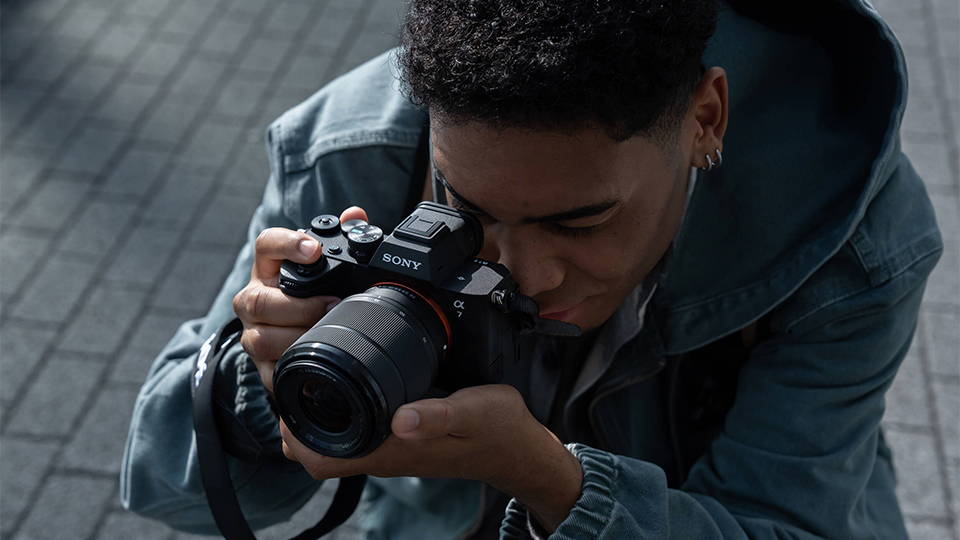
The key upgrade to this lens relates to the autofocus system, which now supports AF-C continuous shooting at 120 fps. What this lens has really shown us is how well Sony cameras age. Both the a7 IV and a7 III saw new kits featuring this lens, proving that even years down the line, these old dogs can still hunt.
FE 8-14 f/3.5 Fisheye G Lens
The FE 8-14mm f/3.5 Fisheye G boasts a full 180-degree angle of view across its entire zoom range. As you zoom, the fisheye effect transforms from a circular look at the wide end to a diagonal one at 14mm. Like many of Sony’s more recent lenses, the 8-14mm features independent focus, zoom, and aperture rings with a zoom lock switch and de-clickable aperture ring.

Why are fisheyes so important? These lenses deliver dramatic, distorted views that can create a POV effect unlike anything produced by other lens styles. Some photographers attempt to correct this warped look in post; however, the effect can certainly stand on its own. After all, if you want a less distorted view, use a traditional wide-angle lens. Sony certainly has a few. In fact, Sony has quite a few lenses in each category nowadays, including some snazzy new super telephotos.
FE 100-400mm f/5.6-8 OSS
When it comes to super-telephoto lenses, few fit into the “affordable” price range. Those looking to delve into the world of sports or wildlife photography are often told that they need a lot of time and a lot of money to make it work, but this isn’t always the case. Especially when brands like Sony go out of their way to make these longer lenses more accessible, and that’s exactly what they did here. Introducing the smallest and lightest of these long lenses, the compact FE 100-400mm f/5.6-8 OSS.

This lightweight super zoom goes a long way to not only make long telephoto focal lengths cost effective but travel friendly as well. At just 1.4 lb, this lens is ready for nearly every adventure. It’s compatible with full-frame cameras, capable of keeping up with the incredible speeds of Sony’s fastest Alpha series bodies ,and even offers dust and moisture resistance. Not too shabby for such a lens at this price point.
FE 100-400mm f/4.5 GM OSS
Those of us who appreciate a super-telephoto lens may feel overwhelmed this year, as Sony upgraded the entire 400mm lineup from the ground up, delivering an affordable zoom, a compact prime, and this unique take on the classic zoom range. With a constant f/4.5 aperture and that tank-like G Master construction, the FE 100-400mm f/4.5 GM OSS sits in a league of its own, bridging the world of zooms and exotic primes.

With two existing 100-400mm lenses already, who exactly is this speedier iteration for? The additional speed, or light gathering capabilities, are perfect for sports and action photographers. As natural lighting dwindles, that extra bit of light can go a long way. It keeps ISO values in check, while allowing users to get the shutter speeds they need. That said, this lens can also serve wildlife shooters.
Whether it be your main lens or a companion to a larger prime, this new 100-400mm lens is sure to please. It renders backgrounds beautiful and noticeably softer than other zooms from Sony. Plus, it takes both 1.4x and 2x teleconverters for additional reach.

FE 400mm f/4.5 GM OSS
At this point, we can safely say that Sony has enough 400mm lenses in their lineup. The newest offering comfortably sits one notch below the top slot, which belongs to the flagship, the grand poohbah of lenses, the big enchilada itself, otherwise known as the FE 400mm f/4.5 GM OSS. While fast, this behemoth is large and can fill a backpack on its own with little help. For those seeking a fast 400mm prime, but wanting to save on weight, look no further than the FE 400mm f/4.5 GM OSS. At just under 2.2 lb, this prime is incredibly portable while delivering sharpness akin to its larger cousin.

The only thing that could make this lens more enticing would be a little extra focal length. Sure, you could put a 1.4x or even a 2x teleconverter on this lens without issue, but a longer prime would offer even greater reach. Perhaps 600mm would be enough to draw in photographers who are aiming to shoot smaller birds and more distant subject matter. If only …
FE 600mm f/6.3 GM OSS
Just when you think you’re out, Sony pulls you back in with yet another lightweight super-telephoto lens. If the 400mm f/4.5 is almost perfect, than the FE 600mm f/6.3 GM OSS might just hit the mark. It’s incredibly similar to the 400mm, sharing the same overall design, a similar weight, and a 95mm filter thread. One could argue that it almost looks like the 400mm with a 1.4 teleconverter built into the barrel, and that’s OK, as this means you can get even more reach with external TCs.

Both the 600mm and 400mm serve to better bridge the gap between affordable zooms and the borderline unattainable primes. If you’d like to know more about how both of these lenses perform, we had a chance to take this lens and its shorter 400mm sibling into the field earlier this year. Be sure to check out our hands on review to learn more.
What’s Next?
Sony certainly pulled no punches in 2026, delivering many long-awaited products like the a7RVI and RX10 V, and two ultra-compact super-telephoto primes. They even through in some curveballs with their two 100-400mm zooms, earning Sony the unofficial award of “Most 400mm lenses in the lineup,” a title previously held by Nikon.
With so many exceptional releases, what could Sony possibly have in store for us in 2027? We don’t know, and we’re not going to guess. We’re not in the rumors business, so we’re not going to speculate. That said, you can be the first to learn about all future releases when you sign up to receive our newsletter.
If you’d like to learn more about photography, be sure to check out our other guides, articles, and reviews on the B&H Explora page!
